Kasper’s Not So Friendly Ghosting Act
Marco Kasper has struggled to find the net in year two, what is going wrong and can he turn it around?

Around this time last year, the Detroit Red Wings were in a free fall in the standings that ultimately cost Derek Lalonde his coaching job at Christmas. Todd McLellan made an immediate impact to change the team’s fortunes as they reeled off a pair of seven-game winning streaks shortly after he took over to get back into the playoff hunt, finishing five games behind Montreal for the final postseason slot.
One of the catalysts of that turnaround was the improved play of a rookie Marco Kasper. After getting his feet wet and only producing seven points in his first 35 games, the Austrian forward ended the year on a heater that saw him skate on the top line with Dylan Larkin and Lucas Raymond before settling in as a second-line center between Alex DeBrincat and Patrick Kane. Here’s what he did in the final 42 games from January 10th to the end of the season:
17 goals (2nd on the team)
30 points (5th)
+12 (1st)
29 even strength points (1st)
95 hits (2nd)
53.1 CF% (3rd)
93 shots (5th)
The Difference a Year Makes
With the Red Wings leading the Atlantic Division race at 37 points, things are looking promising as Detroit tries to end its postseason drought. However, Marco Kasper’s production of four points in 31 games is resembling his first half of last year more than the step forward he took in the last three months. He has gone from consistently centering the second line to a bottom six role breaking in rookie Nate Danielson, who admittedly has perked up of late. His assist at Vancouver on Dec. 8 was his first point in 18 games and he has been held without a point in 28 of his first 31 games. With veterans Andrew Copp and JT Compher both taking turns with mixed results as the team’s second line center and Detroit struggling immensely to produce offense at 5-on-5, the opportunity and need for Kasper to recapture his second half form is there.
We have 66 games of data saying Kasper is a fourth line player or healthy scratch and 42 games saying he is a strong second-line center who moves the needle in the positive direction.
Ignoring the team’s goaltending struggles (though John Gibson did post his first shutout of the year at Vancouver), Marco Kasper is the most important player for the Red Wings to make the playoffs for the first time since 2016. Not their best player, but their most important to take the pressure off the elite production of Larkin, Raymond and DeBrincat to have a threat on the ice at even strength when that line isn’t there.
So what gives with Marco Kasper this year? He has moved up and down the lineup throughout. Through 31 games, Kasper has played at least nine 5-on-5 minutes with nine different line combinations, as shown below.
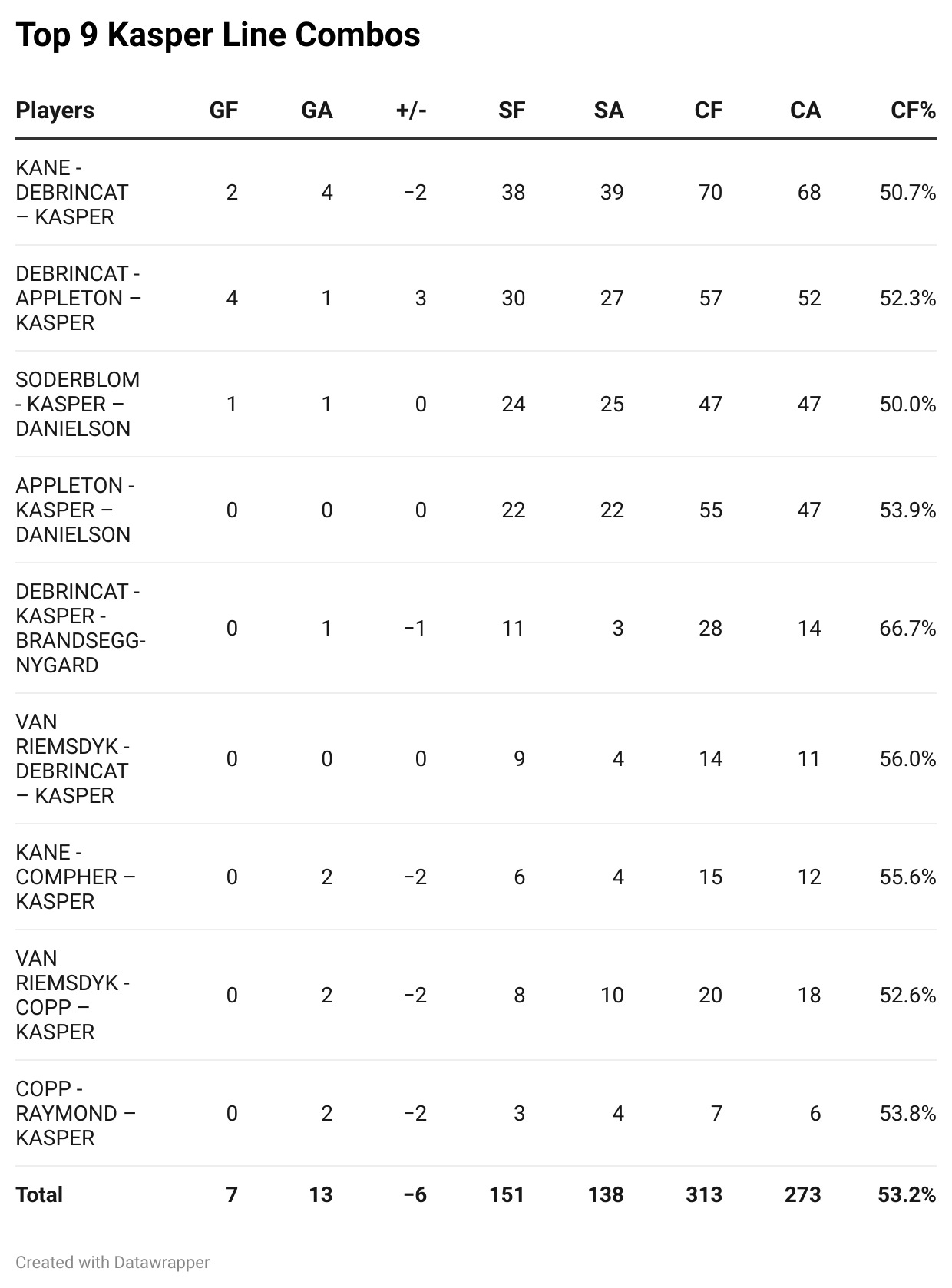
These nine combinations with Kasper have played roughly 293 minutes at 5-on-5 and average 30 shots on goal per 60 minutes and are +13 overall in shots on goal. All nine combinations are 50% Corsi or above. Yes, this includes several top six caliber forwards with Alex Debrincat accounting for four of nine groups, but it also includes long in tooth veterans like James van Riemsdyk, career grinders such as Mason Appleton and disappointing contracts like Andrew Copp and JT Compher with top winger Lucas Raymond appearing just once in this group. Anywhere you put Kasper, play tilts in the opponent’s end.
Unfortunately for Kasper, the puck possession his play brings has simply not translated into goals this year. These units have been outscored 13-7 and the bulk of those seven goals scored came during a period where Appleton replaced an injured Patrick Kane on the second line when the Wings came out the gate hot and won five in a row after an opening-night loss to Montreal.
Last season, the line combination of Kasper, DeBrincat and Kane posted a Corsi% of 52.1% and outscored opponents, 9-4 at even-strength. While the possession metrics are a bit lower with that combination this year, it is still above 50 percent.
Isolating Kasper’s contributions as best as possible from an individual standpoint, here’s a look at a few rate stats in time crunches over the past two seasons, the first 35 games of his rookie year, the last 42 games of the same season and his 2025-26 performance to date.
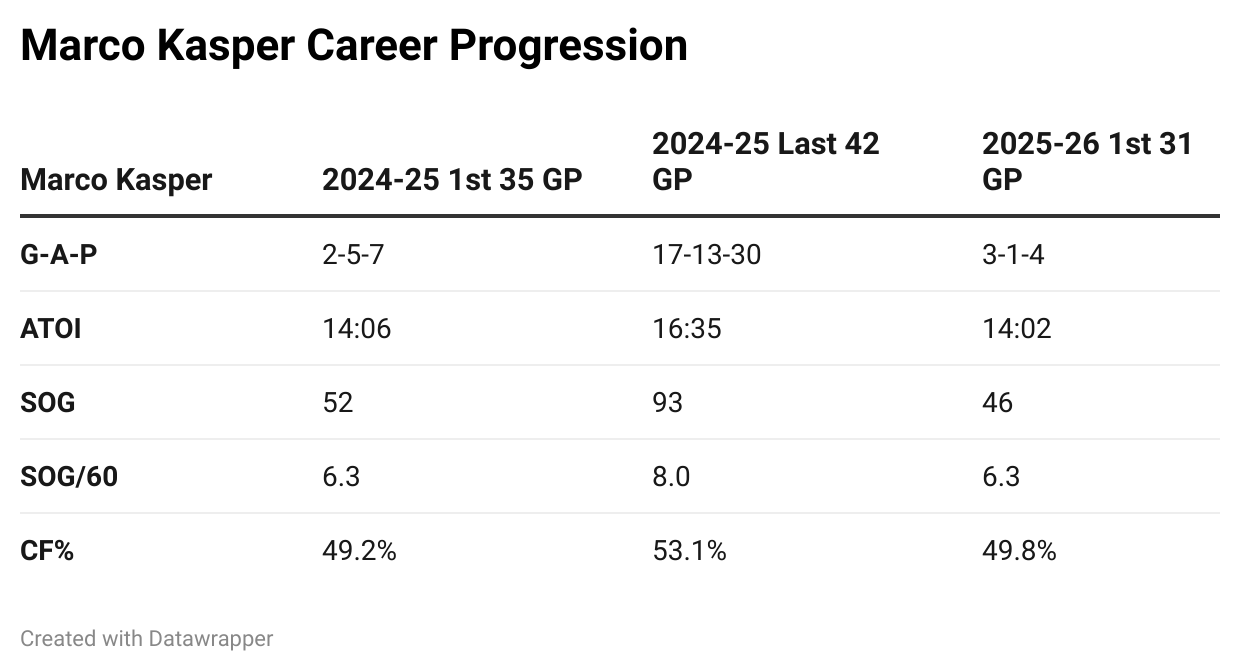
Might Kasper simply be a streaky player? Prorate those bookends and that hot stretch in the middle over 82 games and you have the following players.
Kasper A: 6 goals, 7 assists, 13 points
Kasper B: 33 goals, 25 assists, 58 points
We have 66 games of data saying Kasper is a fourth line player or healthy scratch and 42 games saying he is a strong second-line center who moves the needle in the positive direction.
The growing sample size of production on par with a career fourth liner is concerning, but over a full 82-game season, the stretch he closed last year on absolutely belongs as a second-line center. While his 18.3% shooting percentage is on the high side during the second half of his rookie year, it would barely crack the top 30 among NHL skaters that season. That level of play is sustainable and in there somewhere for Kasper. That said, if a deal for say Quinn Hughes materializes, it is worth listening if Kasper is a name the other team insists on.
Hang On A Second (Line)
Beyond Kasper in a vacuum, you also need to compare how that second line is doing with each center that has been used. For this, I used Alex DeBrincat’s line combinations, as he has been a mainstay in the top six throughout the season and has been an elite possession driver since joining the Red Wings. Here’s what I’ve got:
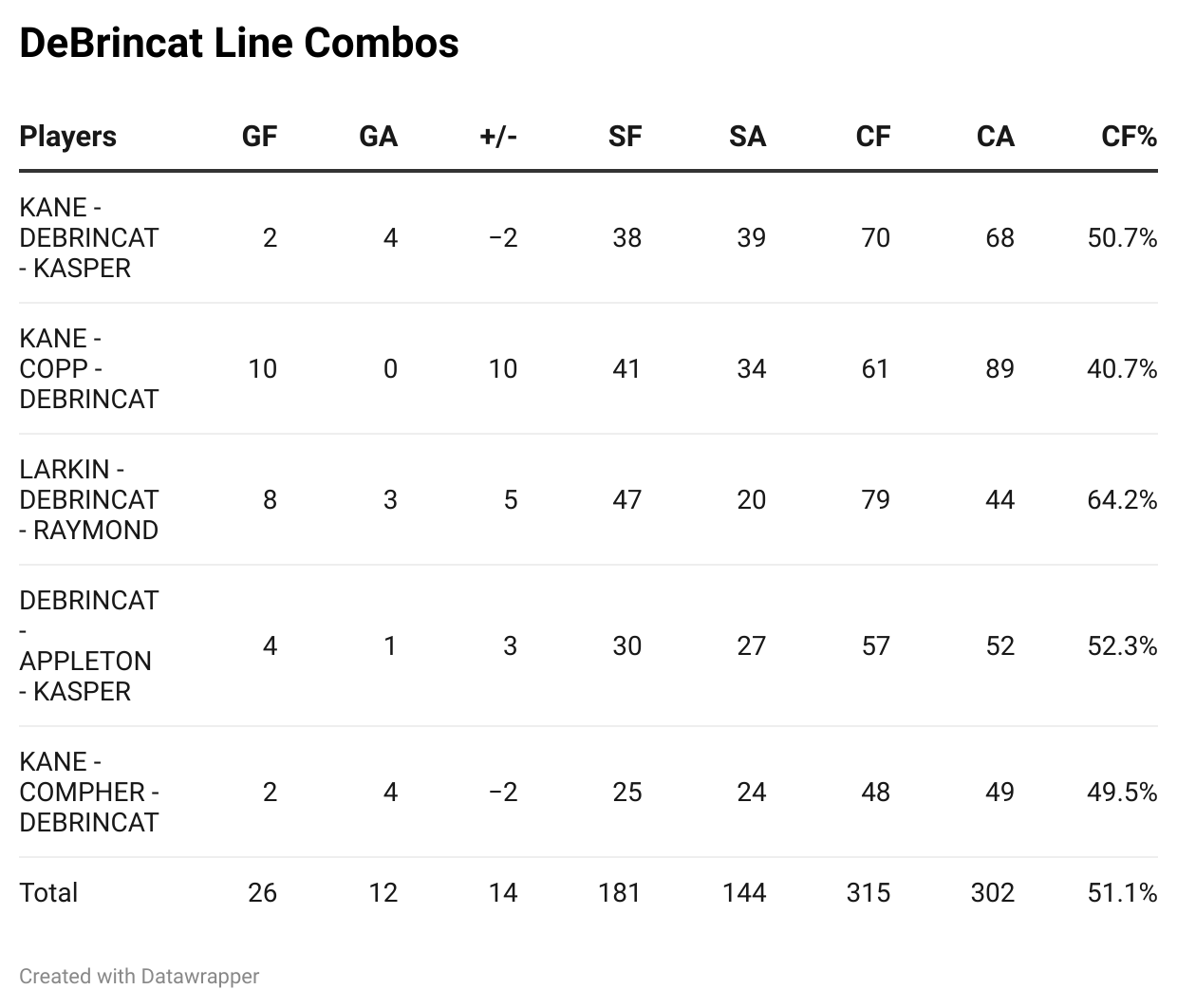
Ignoring the super line he formed with Larkin and Raymond at points this season, DeBrincat’s line has carried play best when Kasper has been on it. However, the group of Kane, DeBrincat and Kasper that ended last season so well is -2 in goal differential this season. The man Kasper replaced last season due to injury, Andrew Copp, has centered this line for 69:33 and has a paltry 40.7% Corsi rating, though admittedly they have more shots on goal taken than allowed. Despite spending way more time in the defensive zone than you want a top-six line to do, this combination has outscored opponents 10-0 this season and its +10 goal differential is the best on the team through 31 games.
So which player is Kasper? The highly drafted player who turned a corner around this time in his rookie season, or the intriguing guy with a high motor whose play isn’t making an impact on the scoreboard? I tend to be more of a process over results (because a good process generally leads to the results) guy. While the drop off in production is alarming, Kasper is still just 21 years old and already nearly posted a 20 goal, 20 assist season in the NHL as a 20-year-old rookie. Player development is not always linear and I sense that while Kasper’s course may be circuitous, he can be a difference maker as a second-line center for a long time. For now, monitoring his progress as he plays with Danielson makes sense, but I would be moving him back with DeBrincat and Kane the second he starts to regain his scoring touch.
How optimistic are you that Kasper shakes off his sophomore slump? Let me know in the comments.